Ecommerce SEO in 2026: The Strategy That’s Working for Online Stores That Can’t Afford to Guess
 Admin
Published
Updated DeskTechnology
Admin
Published
Updated DeskTechnology
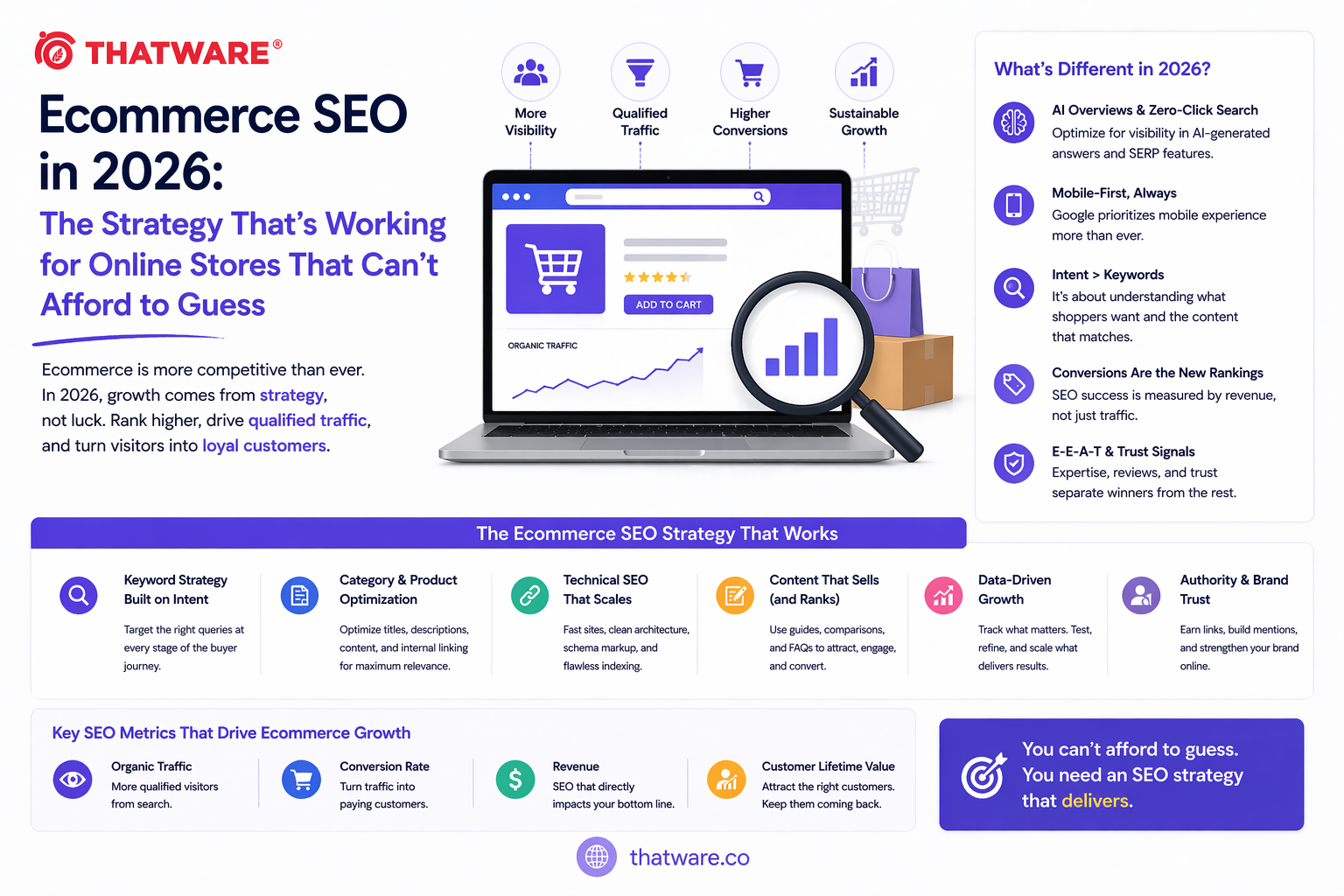
Running an online store in 2026 and trying to grow organically is harder than it was three years ago. Google’s AI Overviews are eating product research queries. PPC costs in most product categories have gotten brutal. And the SEO playbook that worked in 2020 – produce product pages, build some links, wait – produces much thinner results in the current environment.
What actually works now is different. Not unrecognizable – the fundamentals still matter – but the layer on top of the fundamentals has changed substantially.
The Core Problem with Ecommerce SEO in 2026
Ecommerce sites face a structural SEO challenge that content sites don’t: massive numbers of pages, most of them thin, with duplicate or near-duplicate content across product variations, filtered navigation pages, and paginated results. That content structure creates crawl budget problems, duplicate content issues, and diluted authority – all of which suppress rankings.
Most ecommerce SEO problems ultimately trace back to this architecture issue. You can write better product descriptions and build more links, but if Google is confused about which pages should rank and is spending crawl budget on thousands of low-value filtered pages, you’re managing symptoms rather than causes.
The foundational work – proper faceted navigation handling, canonical strategy, crawl budget optimization, site architecture aligned with topical authority – is unglamorous but essential.
Category Pages Are the Real Opportunity
Here’s something that many ecommerce operators underinvest in: category pages. Individual product pages are important, but the highest commercial-intent searches – the ones with the biggest traffic and conversion potential – often land at the category level. “Running shoes for women,” “kitchen knife sets,” “wireless headphones under $100” – these are category-level queries, and the pages that rank for them are usually well-optimized category pages, not individual product pages.
Strong ecommerce SEO spends disproportionate effort on category page optimization – both the informational content layer that demonstrates topical authority and the technical structure that allows clean indexation and strong internal link flow.
Product Page Content That Actually Ranks
Manufacturer-supplied product descriptions are an ecommerce SEO trap. Every store selling the same products has the same descriptions. That’s technically duplicate content and it’s also content that provides zero differentiation from a quality signal perspective.
Investing in original product content – that actually answers the questions customers ask, addresses the specific use cases for the product, and demonstrates real knowledge of what makes one option better than another – creates content that can rank and convert better when it does. ecommerce seo services that are genuinely effective always prioritize content differentiation on high-priority product pages.
The Reviews Ecosystem
User-generated reviews are among the most valuable SEO assets an ecommerce site can have. They create fresh, unique content at scale without requiring editorial investment. They provide the specific language that customers use in search – language that may not appear in brand-produced descriptions. They’re credibility signals for both users and search engines.
Building a systematic reviews capture program – through post-purchase email sequences, easy review interfaces, and explicit asks – is an underinvested SEO strategy for most ecommerce operators. The stores that have built large, genuine review volumes have a compounding advantage that’s hard to catch up to.
Schema and Structured Data
Ecommerce has some of the richest structured data opportunities in all of SEO. Product schema, review schema, price schema, availability schema, breadcrumb schema – all of these create opportunities for rich snippets and enhanced search result presentations that improve click-through rates.
Implementation quality varies enormously. Poorly implemented schema creates errors that can actually harm rather than help. Well-implemented, comprehensive structured data is an underutilized advantage for most ecommerce sites.
What a Good Ecommerce SEO Agency Does Differently
The difference between a generic agency taking on ecommerce clients and a specialist ecommerce SEO Agency operation shows up in a few specific areas. Technical audit depth – do they understand JavaScript rendering issues specific to ecommerce platforms? Category strategy – do they have a framework for identifying the highest-opportunity category targets and building authority toward them systematically? Content economics – do they have an approach to scaling product content improvement without requiring manual writing for every SKU?
These are ecommerce-specific questions with ecommerce-specific answers. Agencies that can answer them well are positioned to deliver results in what is genuinely one of the harder SEO environments in 2026.
The Paid-Organic Integration Question
One final point that often gets left out of ecommerce SEO discussions: the relationship between paid and organic search is more important than most practitioners acknowledge. PPC data is a goldmine for organic keyword strategy – it tells you which terms actually convert, at what rate, with what intent. Organic growth in the right categories can meaningfully reduce dependence on paid channels that have gotten increasingly expensive.
Ecommerce operations that treat paid and organic as entirely separate functions, optimized by separate teams with separate goals, leave significant strategic value on the table. The best ecommerce growth strategies in 2026 treat them as complementary channels that inform each other.